
Demystifying SASE: The Unified Future of Network Architecture and Cloud Security

Demystifying SASE: The Unified Future of Network Architecture and Cloud Security

The traditional corporate network perimeter is dead. For decades, businesses operated on a “castle-and-moat” security model: corporate assets lived inside a physical data center, employees worked from a centralized office, and a perimeter firewall kept threats out. However, the rapid adoption of cloud platforms like AWS, Microsoft Azure, and Google Cloud, combined with the permanent shift toward remote and hybrid work, has rendered this legacy infrastructure obsolete.

When remote employees have to route their traffic back to a physical corporate headquarters just to clear a security check before reaching a SaaS application, it creates severe bottlenecking and network lag. Businesses need a network design that secures data directly at the edge—wherever the user happens to be. This is where Secure Access Service Edge (SASE) comes in.

What is Secure Access Service Edge (SASE)?

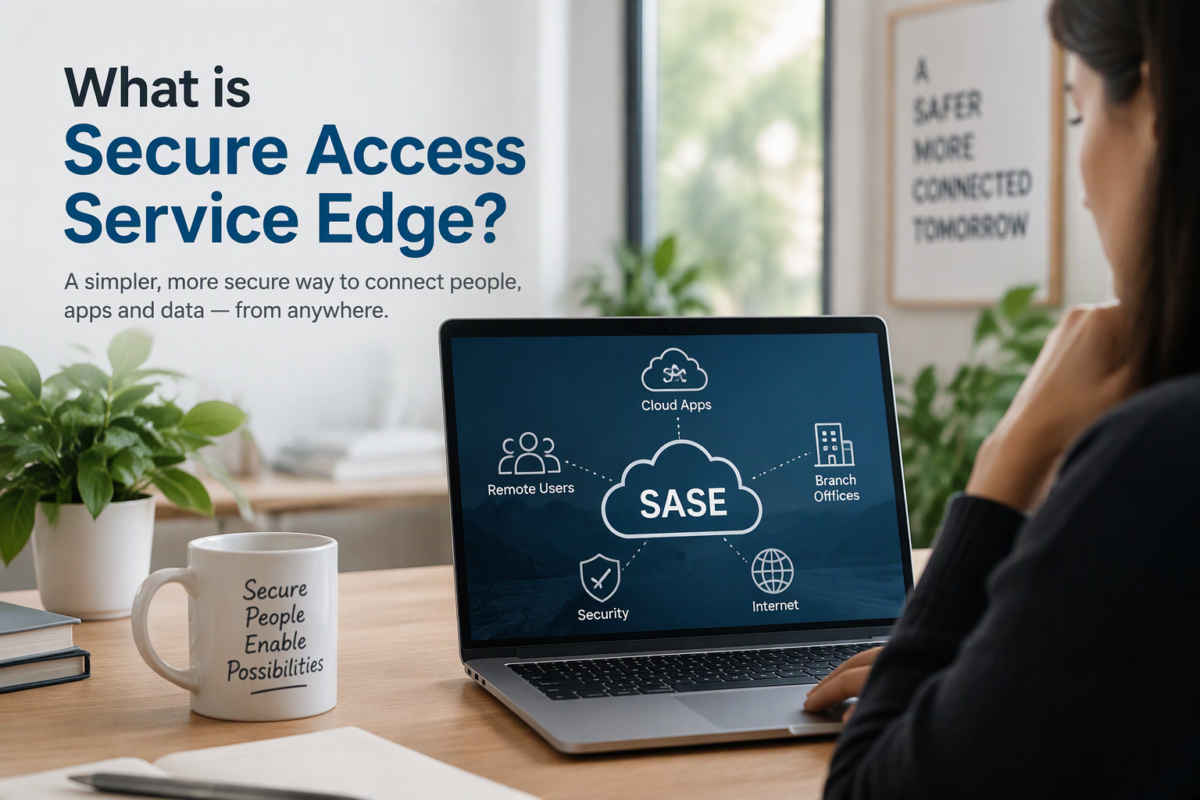
Coined by global research firm Gartner, Secure Access Service Edge (SASE)—pronounced “sassy”—is a progressive cybersecurity and networking framework. It converges wide-area networking (WAN) capabilities with comprehensive, cloud-delivered security functions into a single, unified platform.

Instead of managing separate point solutions for routing, firewalls, and remote access, SASE pools these services into a globally distributed cloud architecture. Security policies are managed centrally but enforced locally at cloud Points of Presence (PoPs), ensuring low latency and consistent protection.

The Architectural Pillars of SASE

A true SASE architecture is built by combining two distinct technology spaces: advanced network routing and a unified security stack known as Security Service Edge (SSE).

1. Network as a Service (The Routing Component)

    • SD-WAN (Software-Defined Wide Area Network): The connective tissue of SASE. SD-WAN dynamically manages and measures traffic across multiple connection types (such as broadband, LTE, or 5G). It automatically steers critical business traffic along the fastest path, ensuring high application performance.

2. Security Service Edge / SSE (The Security Component)

    • Zero Trust Network Access (ZTNA): Replacing legacy VPNs, ZTNA works on the philosophy of “never trust, always verify.” It checks user identity, device health, and context before granting access only to the specific internal application required, preventing lateral movement across a network.
    • Secure Web Gateway (SWG): A cloud-native web filtering solution that inspects web traffic to block malicious URLs, prevent malware downloads, and enforce corporate internet usage policies.
    • Cloud Access Security Broker (CASB): A critical gatekeeper for SaaS applications. CASB protects sensitive corporate data by monitoring file uploads, shares, and data transfers, effectively preventing data leaks to unauthorized public clouds.
    • Firewall as a Service (FWaaS): An enterprise-grade, next-generation firewall hosted entirely in the cloud. It scales up or down automatically to inspect traffic across all ports and protocols without relying on on-premise hardware.

Key Benefits of the SASE Model

Transitioning from fragmented, legacy infrastructure to a streamlined SASE framework offers measurable operational advantages for growing enterprises:

    • Reduced Overhead and Complexity: Businesses can consolidate their technology stack. Instead of managing independent licensing, updates, and configurations for multiple security vendors, everything is controlled from one unified dashboard.
    • Optimized User Experience: Remote users no longer suffer through sluggish VPN connections. By connecting directly to the nearest localized cloud node, latency drops significantly.
    • Uniform Security Posture: Whether an executive is working from headquarters or a remote contractor is logged in from a public coffee shop, the exact same threat filtering, device profiling, and data loss prevention policies apply.

How to Prepare Your Infrastructure for SASE

Deploying a SASE architecture is an evolutionary journey that relies on a rock-solid infrastructure foundation. Before converging your security into the cloud, your core hosting environments must be highly secure, performant, and reliable.

Organizations looking to scale into a SASE model can leverage foundational services to facilitate the shift:

    • Multi-Cloud Integration: Modern networks rely heavily on cloud-hosted application environments. Utilizing specialized architectural planning tools—such as a dedicated Google Cloud calculator, Azure calculator, or AWS calculator—allows you to right-size your workloads before layering on cloud security perimeters.
    • Isolated and Dedicated Environments: For mission-critical internal databases or legacy business logic that cannot easily move to public SaaS, deploying independent environments like Dedicated Servers ensures you maintain total control over data sovereignty and root access, making ZTNA policies easier to map out.
    • Accelerated AI Workloads: If your network infrastructure relies on high-compute operations, utilizing cloud-adjacent virtual infrastructure like a GPU VPS or dedicated GPU nodes can handle heavy data parsing while your SASE edge manages secure transport.
    • Baseline Encryption & Website Defense: Long before network traffic ever reaches an internal system, external access points must be hardened. Implementing enterprise-grade SSL Certificates ensures data encryption in transit, while active malware scanning and DDoS mitigation protect public-facing applications.

Conclusion

Secure Access Service Edge is not just a passing trend; it is a fundamental reconfiguration of how modern, distributed businesses approach cybersecurity and networking. By unifying network routing with cloud-delivered security, SASE eliminates latency, slashes hardware complexity, and protects your corporate data no matter where it travels.
What is Secure Access Service Edge (SASE)? Requirements, Benefits, and Challenges

What is Secure Access Service Edge (SASE)?

In today’s rapidly evolving digital landscape, enterprises are increasingly relying on cloud technologies, remote workforces, and global networks. This shift has given rise to the need for a modern security framework that can address the unique challenges of a decentralized network. Enter Secure Access Service Edge (SASE), a cloud-based security architecture that merges network and security functions into a unified platform.

Understanding SASE

SASE (pronounced “sassy”) was coined by Gartner in 2019 and represents a transformation in how enterprises handle secure network access. Traditionally, businesses relied on a centralized data center for managing network security. However, with more applications being hosted in the cloud and employees working remotely, SASE allows for direct-to-cloud connections while ensuring robust security controls are in place. It combines several critical functions, including Software-Defined Wide Area Networking (SD-WAN) and cloud-delivered security services like Secure Web Gateway (SWG), Cloud Access Security Broker (CASB), Zero Trust Network Access (ZTNA), and Firewall-as-a-Service (FWaaS).

Requirements for Implementing SASE

To effectively implement a SASE architecture, organizations need to consider the following:

  • Cloud-native Infrastructure: SASE operates as a cloud-based platform, so a cloud-native approach is essential for scalability and flexibility.
  • Edge Computing: Edge computing capabilities allow for lower latency and faster response times by processing data closer to the user or device.
  • Zero Trust Network Access (ZTNA): Authentication and security policies must be established that assume no user, device, or application should be trusted by default.
  • Integrated Security Services: SASE consolidates SD-WAN, SWG, CASB, ZTNA, and FWaaS into a unified framework.
  • Global Network: SASE requires a distributed, global network to ensure fast and secure access across diverse geographic locations.
  • Automation and Analytics: Real-time monitoring, analytics, and automated threat detection are vital for ensuring security in a dynamic network environment.

Key Components of SASE

The core elements that make up the SASE framework include:

  • SD-WAN: Provides optimized and reliable connectivity between users, applications, and cloud services by routing traffic over multiple network links.
  • Zero Trust Network Access (ZTNA): Enforces strict identity verification for each user or device before granting access to resources.
  • Firewall as a Service (FWaaS): Cloud-delivered firewall services that protect against network threats and attacks.
  • Cloud Access Security Broker (CASB): Monitors and controls access to cloud-based applications, ensuring secure usage and compliance.
  • Secure Web Gateway (SWG): Protects users from online threats by filtering and monitoring web traffic.

The Importance of SASE for Enterprise Networks

SASE is particularly important for enterprises that rely heavily on cloud infrastructure and remote work. It simplifies network management by eliminating the need for multiple on-premises security devices and provides a more flexible, scalable solution for securing cloud environments. Additionally, SASE helps organizations reduce latency, improve performance, and enhance security by using a unified architecture that adapts to modern networking needs.

Benefits of SASE

SASE offers several key benefits for enterprises:

  • Cost Efficiency: By consolidating multiple security solutions into one cloud-based platform, organizations reduce costs associated with hardware, software, and maintenance.
  • Scalability: SASE allows businesses to scale their network and security services according to demand, providing a flexible and future-proof solution.
  • Improved Performance: Direct-to-cloud connectivity reduces latency, improves application performance, and enhances the user experience.
  • Enhanced Security: With Zero Trust policies, integrated threat protection, and real-time monitoring, SASE provides robust protection against both internal and external threats.
  • Agility: SASE adapts to changing business environments, enabling quick deployment of security policies across dispersed networks.

Challenges in Implementing SASE

Despite its benefits, there are some challenges associated with implementing SASE:

  • Complexity: Transitioning from legacy systems to SASE can be complex and requires significant planning and coordination.
  • Integration with Existing Systems: Integrating SASE with existing security tools, applications, and network configurations can be difficult for some enterprises.
  • Cost of Initial Implementation: While SASE is cost-effective in the long run, initial setup and migration can require a significant investment.
  • Skills Gap: Enterprises may need to train their IT teams to understand and manage SASE effectively, which could pose a challenge for some organizations.

Risks and Threats Associated with SASE

While SASE strengthens security, it still faces certain risks and threats:

  • Cloud Dependence: A major reliance on cloud infrastructure increases the risk if the cloud provider experiences an outage or a security breach.
  • Configuration Errors: Misconfigurations in SASE setup could lead to potential security gaps, making the network vulnerable to attacks.
  • Insider Threats: Zero Trust policies help mitigate insider threats, but risks still exist from authorized users who could exploit their access privileges.
  • Data Privacy Concerns: As SASE consolidates network and security data, ensuring the privacy of sensitive data becomes a primary concern.

Conclusion

Secure Access Service Edge (SASE) is a transformative solution for enterprises seeking to modernize their security and network architectures. It provides a cloud-native, scalable, and flexible framework that integrates multiple security services, reducing complexity and cost. While SASE offers numerous benefits, businesses must carefully plan their implementation to overcome potential challenges and risks. In an increasingly cloud-driven world, SASE is crucial for organizations aiming to stay ahead in terms of security, performance, and scalability. For your Corporate SASE needs contact our Security Expert, Open a Support Ticket.