
Navigating the Shopify Ecosystem: A Beginner’s Map
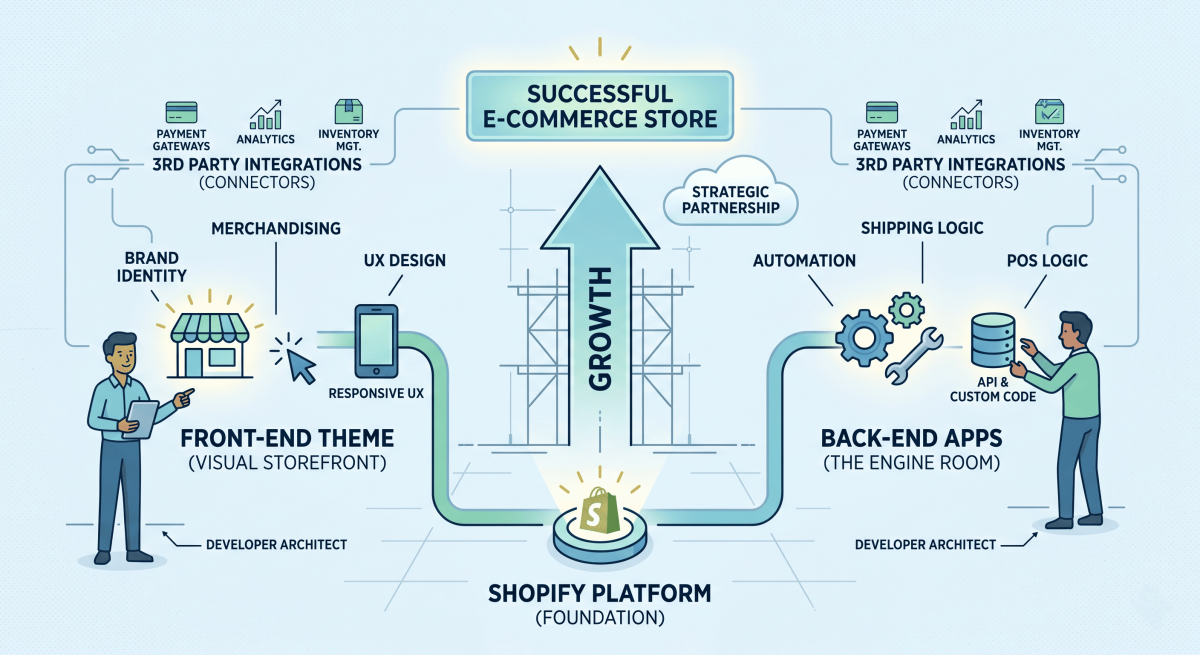
To understand Shopify is to understand the architecture of modern retail. In the e-commerce realm, Shopify stands as the premier software environment for hundreds of thousands of brands globally. As an educator, I view the platform as the “foundation,” but the developer acts as the “architect.”
Shopify is a “robust, scalable, and sophisticated” software platform designed to allow businesses to run modern e-commerce operations with ease and efficiency.
The “So What?” for Business Owners: While Shopify is highly accessible, there is a significant structural gap between a store that uses a “basic template” and one that commands a “competitive edge.” Professional expertise is the bridge across this gap. A developer doesn’t simply “launch” a site; they create a high-performing digital environment where technical scaffolding supports business growth.
To build a successful store, we must first look at the “skin” of the website: the Front-End Theme.
Front-End Theme Design: The Digital Storefront
The Mental Model: Think of the Front-End Theme as the merchandising and lighting in a physical retail store. It is the visual and interactive layer that dictates how customers perceive your brand the moment they walk through the door.
Theme design and development are responsible for everything the customer sees, clicks, and experiences. Professional architects create entirely new themes from scratch or customize existing ones to ensure they are not just “aesthetic,” but highly functional.
- Brand Identity: Developers create themes that align perfectly with a business’s specific goals. This ensures your digital storefront reflects the unique heart of your brand rather than looking like a generic carbon copy of your competitors.
- User Experience (UX): A tailored theme meets specific user needs, creating a “frictionless” path to purchase. Excellent UX design removes the “clutter” that often leads to high bounce rates and abandoned carts.
- Responsiveness: In a mobile-first world, your store must be “fluid.” Custom theme development ensures that the design is responsive, meaning it adapts perfectly to phones, tablets, and desktops to provide a high-quality experience on any device.
While the theme handles how the store looks, we need a different kind of expertise to handle how the store thinks.
Back-End App Development: The Engine Room
The Mental Model: If the theme is the showroom, the Back-End is the stockroom automation and POS logic. This is where the heavy lifting happens—calculating complex shipping rates, managing loyalty logic, or syncing data across systems.
Shopify App Development involves creating tailored functions that are not available “out-of-the-box.” This involves the use of custom code and API integrations to solve specific business problems that standard themes cannot handle.
| Feature Category | The Breakdown |
| Architectural Purpose | Themes focus on the visual layer and UX; Apps focus on unique business logic and tailored functions. |
| Primary Technical Focus | Themes focus on Brand Identity and Responsiveness; Apps focus on solving “Engine Room” requirements and custom code. |
| Result for the Customer | A beautiful, engaging site (Theme) supported by smooth automation and specialized features (Apps). |
A powerful engine is great, but it needs to talk to the rest of the world through third-party integrations.
The Art of Integration: Connecting External Tools
A Shopify developer acts as a technical “connector.” They link your store to the massive external ecosystem required for global trade. To ensure this communication is high-performance, expert providers utilize professional infrastructure, such as private networking for clustered servers and high-capacity connections featuring up to 550 GB/s of internet bandwidth.
The Integration Lifecycle follows this sequence:
- Identifying the Tool: Determining which third-party solution (e.g., Bitcoin payment gateways, Google Analytics, or advanced Inventory Management) solves the business need.
- Technical Setup: Performing the “behind-the-scenes” configuration to ensure the software and Shopify can communicate via secure APIs.
- Data Flow and Automation: Establishing a seamless flow of information so that when an order is placed, inventory is updated and shipments are confirmed automatically without manual entry.
Beyond building the site, there are foundational and high-growth services that keep a business moving forward.
Specialized Tiers: Store Setup and Shopify Plus
Services are often scaffolded based on where a business is in its lifecycle.
Store Setup and Configuration This is the foundational work. It includes setting up the Shopify account, selecting the right plan, arranging payment gateways, and securing a specialized domain to establish a secure online identity.
——————————————————————————–
Shopify Plus is an enterprise-grade solution designed for “fast-growing businesses.” It represents a massive jump in scale, offering:
- Advanced Customization: Greater control over the checkout experience and specialized scripts.
- Expansive API Integration: Connecting your store to massive corporate databases or legacy ERP systems.
- Seamless Migration: Guaranteed data transfer for businesses moving from standard plans or external platforms to the Plus tier.
Even the best-built stores require a safety net of security and ongoing care.
The Safety Net: QA, Security, and Maintenance
Launching a store is just the beginning. To keep a digital business healthy, developers provide a “Safety Net” of technical support and rigorous protection.
The 3 Pillars of Store Health:
- Proactive Quality Assurance (QA): This involves testing across the entire website lifecycle. Architects look at code quality and website performance to identify bugs before a customer ever encounters them.
- Regular Updates and Maintenance: Technical teams keep a close eye on site performance, resolving bugs and issues quickly to ensure the store runs smoothly 24/7.
- Compliance and Security: Security is non-negotiable. Developers implement SSL Certificates to secure online identity and ensure legal compliance. Based on your needs, these range from:
- Domain Validated (DV): Standard protection.
- Organization Validation (OV): Higher trust for businesses.
- Extended Validation (EV): The gold standard for enterprise security.
With the technical facets clear, the final step is understanding the value of a long-term partnership.
Summary: Evaluating Expertise and Value
Hiring a developer is a strategic decision that impacts your bottom line. According to industry data, customized Shopify stores eliminate the need for intermediary stores, which directly boosts profit margins.
While a customized project often requires an investment below 10,000** (with hourly rates averaging **25–$49), the Return on Investment (ROI) is found in higher conversion rates and sales volume. When choosing a partner, prioritize those with an industry track record and a clear approach to e-commerce strategy.
Learner’s Checklist
Use this checklist to evaluate potential Shopify service providers:
- [ ] Technical Track Record: Do they have a portfolio of past projects similar in scale to your industry?
- [ ] Full-Service Capability: Can they handle both the “Skin” (Themes) and the “Engine” (Apps/APIs) to avoid team fragmentation?
- [ ] Project Management Maturity: Do they use professional collaboration tools like Jira or Asana to track milestones?
- [ ] Pricing Transparency: Do they provide a clear price breakdown aligned with the 25–49/hr or $10k project baseline?
- [ ] Training and Documentation: Will they teach your internal team how to manage the store modules independently after launch?
- [ ] Security Expertise: Do they understand the requirements for SSL (DV, OV, or EV) and regional privacy regulations?
- [ ] Cultural and Growth Alignment: Are they capable of supporting your business as you scale toward tiers like Shopify Plus?