
Demystifying SASE: The Unified Future of Network Architecture and Cloud Security
The traditional corporate network perimeter is dead. For decades, businesses operated on a “castle-and-moat” security model: corporate assets lived inside a physical data center, employees worked from a centralized office, and a perimeter firewall kept threats out. However, the rapid adoption of cloud platforms like AWS, Microsoft Azure, and Google Cloud, combined with the permanent shift toward remote and hybrid work, has rendered this legacy infrastructure obsolete.
When remote employees have to route their traffic back to a physical corporate headquarters just to clear a security check before reaching a SaaS application, it creates severe bottlenecking and network lag. Businesses need a network design that secures data directly at the edge—wherever the user happens to be. This is where Secure Access Service Edge (SASE) comes in.
What is Secure Access Service Edge (SASE)?
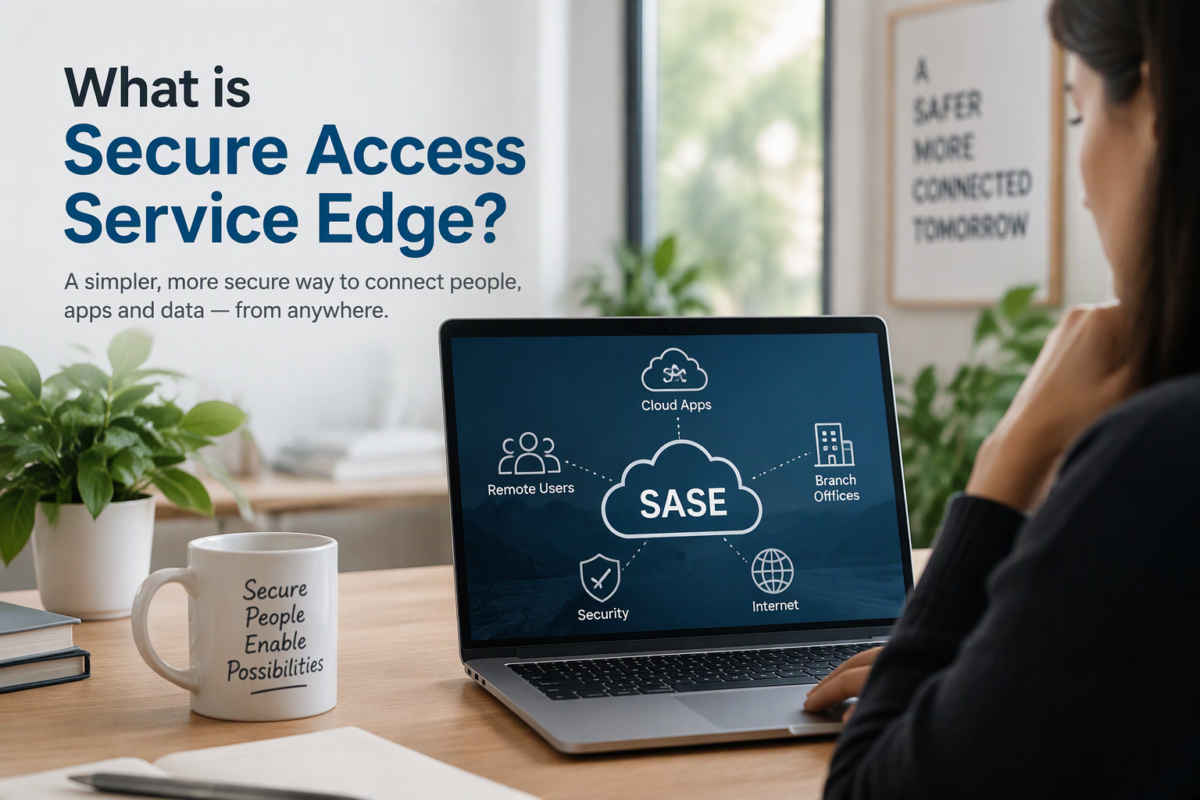
Coined by global research firm Gartner, Secure Access Service Edge (SASE)—pronounced “sassy”—is a progressive cybersecurity and networking framework. It converges wide-area networking (WAN) capabilities with comprehensive, cloud-delivered security functions into a single, unified platform.
Instead of managing separate point solutions for routing, firewalls, and remote access, SASE pools these services into a globally distributed cloud architecture. Security policies are managed centrally but enforced locally at cloud Points of Presence (PoPs), ensuring low latency and consistent protection.
The Architectural Pillars of SASE
A true SASE architecture is built by combining two distinct technology spaces: advanced network routing and a unified security stack known as Security Service Edge (SSE).
1. Network as a Service (The Routing Component)
-
- SD-WAN (Software-Defined Wide Area Network): The connective tissue of SASE. SD-WAN dynamically manages and measures traffic across multiple connection types (such as broadband, LTE, or 5G). It automatically steers critical business traffic along the fastest path, ensuring high application performance.
2. Security Service Edge / SSE (The Security Component)
-
- Zero Trust Network Access (ZTNA): Replacing legacy VPNs, ZTNA works on the philosophy of “never trust, always verify.” It checks user identity, device health, and context before granting access only to the specific internal application required, preventing lateral movement across a network.
- Secure Web Gateway (SWG): A cloud-native web filtering solution that inspects web traffic to block malicious URLs, prevent malware downloads, and enforce corporate internet usage policies.
- Cloud Access Security Broker (CASB): A critical gatekeeper for SaaS applications. CASB protects sensitive corporate data by monitoring file uploads, shares, and data transfers, effectively preventing data leaks to unauthorized public clouds.
- Firewall as a Service (FWaaS): An enterprise-grade, next-generation firewall hosted entirely in the cloud. It scales up or down automatically to inspect traffic across all ports and protocols without relying on on-premise hardware.
Key Benefits of the SASE Model
Transitioning from fragmented, legacy infrastructure to a streamlined SASE framework offers measurable operational advantages for growing enterprises:
-
- Reduced Overhead and Complexity: Businesses can consolidate their technology stack. Instead of managing independent licensing, updates, and configurations for multiple security vendors, everything is controlled from one unified dashboard.
- Optimized User Experience: Remote users no longer suffer through sluggish VPN connections. By connecting directly to the nearest localized cloud node, latency drops significantly.
- Uniform Security Posture: Whether an executive is working from headquarters or a remote contractor is logged in from a public coffee shop, the exact same threat filtering, device profiling, and data loss prevention policies apply.
How to Prepare Your Infrastructure for SASE
Deploying a SASE architecture is an evolutionary journey that relies on a rock-solid infrastructure foundation. Before converging your security into the cloud, your core hosting environments must be highly secure, performant, and reliable.
Organizations looking to scale into a SASE model can leverage foundational services to facilitate the shift:
-
- Multi-Cloud Integration: Modern networks rely heavily on cloud-hosted application environments. Utilizing specialized architectural planning tools—such as a dedicated Google Cloud calculator, Azure calculator, or AWS calculator—allows you to right-size your workloads before layering on cloud security perimeters.
- Isolated and Dedicated Environments: For mission-critical internal databases or legacy business logic that cannot easily move to public SaaS, deploying independent environments like Dedicated Servers ensures you maintain total control over data sovereignty and root access, making ZTNA policies easier to map out.
- Accelerated AI Workloads: If your network infrastructure relies on high-compute operations, utilizing cloud-adjacent virtual infrastructure like a GPU VPS or dedicated GPU nodes can handle heavy data parsing while your SASE edge manages secure transport.
- Baseline Encryption & Website Defense: Long before network traffic ever reaches an internal system, external access points must be hardened. Implementing enterprise-grade SSL Certificates ensures data encryption in transit, while active malware scanning and DDoS mitigation protect public-facing applications.
Conclusion
Secure Access Service Edge is not just a passing trend; it is a fundamental reconfiguration of how modern, distributed businesses approach cybersecurity and networking. By unifying network routing with cloud-delivered security, SASE eliminates latency, slashes hardware complexity, and protects your corporate data no matter where it travels.