Boosting WordPress Performance: Why Your 1 GB+ MySQL Database Demands an NVMe VPS

When you launch a standard WordPress site, a basic hosting environment usually suffices. However, as your portal scales, a hidden performance bottleneck begins to form beneath the surface: your database.

If your WordPress portal is currently driving a 1 GB or larger MySQL database, standard web hosting will no longer cut it. At this scale, every page load triggers complex database queries that can choke traditional server hardware, leading to sluggish load times, high Time-to-First-Byte (TTFB), and frequent timeout errors.

To keep a data-heavy WordPress portal lightning-fast, you need isolated server resources and high-performance storage infrastructure. Let’s dive into why a Systron NVMe VPS is the definitive architectural solution for large WordPress databases, backed by real-world optimization examples and technical performance metrics.

The Root Problem: Why Large WordPress Databases Slow Down

WordPress is inherently dynamic. Unlike static HTML sites, every visit to a WordPress page forces PHP to run multiple requests to your MySQL database to retrieve post content, user data, plugin configurations, and taxonomy relationships.

[User Visit] ➔ [WordPress PHP Engine] ➔ [Multiple MySQL Queries] ➔ [Disk Read/Write]
│
(This is where standard SATA SSDs bottleneck) ◄┘

When your database crosses the 1 GB threshold, several critical resource challenges arise:

    • The I/O Bottleneck: A 1 GB database contains millions of rows of data. Traditional SATA SSDs top out at transfer speeds of around 550 MB/s. When multiple users hit your site simultaneously, the storage disk struggles to process the massive queue of read/write operations (Input/Output Operations Per Second, or IOPS).
    • Memory Exhaustion: If your server does not have enough Random Access Memory (RAM) to cache the frequently accessed parts of your database, MySQL is forced to continuously query the physical storage disk. Disk reading is significantly slower than RAM reading.
    • Unoptimized Queries: Plugins like WooCommerce, advanced form builders, or community forums heavily bloat the wp_options and wp_postmeta tables. Searching through a 1 GB unindexed or bloated database on weak hardware results in severe lag.

Enter Systron NVMe Infrastructure: Shattering the SATA Bottleneck

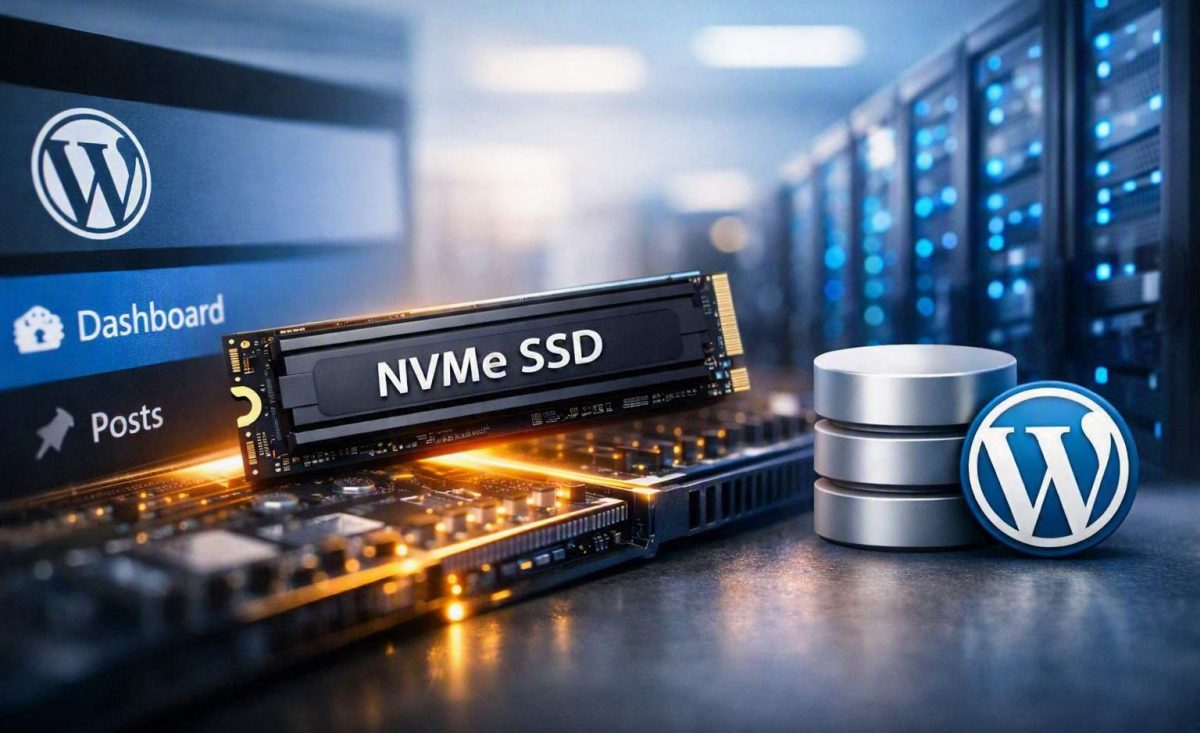
To resolve these resource bottlenecks, Systron.net utilizes advanced Non-Volatile Memory Express (NVMe) architectures across its premium Virtual Private Server (VPS) lineup.

Unlike standard solid-state drives that connect via restrictive, legacy SATA cables, NVMe drives interface directly with the motherboard via high-speed PCIe lanes.

Raw Performance Comparison

Performance Metric Traditional SATA SSD (Budget VPS) Systron NVMe SSD Infrastructure
Read/Write Speeds ~500 to 550 MB/s Up to 3,500 – 7,000 MB/s
IOPS Capabilities ~50,000 to 90,000 IOPS Up to 500,000+ IOPS
Data Pathway Legacy SATA Interface Direct PCIe Lane Connection
Database Execution Queue-bound, causing latency Parallel execution, near-zero lag
By deploying your portal on a Systron NVMe node, your MySQL database can search, index, and retrieve data up to 7 to 20 times faster than on a standard SSD VPS. This drastically reduces your server’s backend processing time, resulting in instantaneous page loads for your visitors.

Concrete Example: Real-World Database Scenarios

To put a 1 GB database into perspective, let’s examine two common WordPress installations and how they behave under different server environments.

Scenario A: The High-Traffic Membership Portal

    • The Setup: A WordPress site with 50,000 registered users, running BuddyBoss and an active community forum. The MySQL database size is exactly 1.2 GB, primarily filled with user metadata, activity logs, and private messages.
    • On a Standard SATA VPS: When 50 users attempt to log in or post updates at the same time, the server hits its IOPS ceiling. The disk cannot keep up with concurrent database writes. Users experience 5-second page delays, and the server intermittently drops connections with 502 Bad Gateway or Error Establishing a Database Connection messages.
    • On a Systron NVMe VPS: Because Systron’s hardware handles hundreds of thousands of concurrent IOPS, the parallel data channels process login verifications and forum writes instantaneously. The database queries execute in milliseconds, keeping resource utilization low even during peak traffic hours.

Scenario B: The WooCommerce Enterprise Store

    • The Setup: An e-commerce store with 10,000 products, complex variable attributes, and a massive wp_postmeta table totaling 1.5 GB.
    • The Problem: Shoppers using the filtered search bar to look for products trigger massive, resource-heavy SQL query strings (SELECT * FROM wp_posts WHERE…).
    • The Systron Advantage: Utilizing Systron’s U.2 NVMe storage blocks combined with isolated CPU cores, product filtering and checkout operations happen seamlessly. Database reads do not back up, eliminating shopping cart abandonment caused by slow checkout pages.

Choosing the Right Systron VPS Architecture for Your Portal

Systron offers two distinct pathways depending on your internal technical expertise and administrative preferences. Both options leverage top-tier storage components but differ in management style.

Option 1: The Hands-Off Approach – Systron Managed NVMe SSD VPS

If you prefer to focus entirely on your content, marketing, and business operations without worrying about server configurations, security patches, or command-line updates, the Systron Managed NVMe SSD VPS tier is highly recommended.

    • Recommended Blueprint: A plan configured with at least 2 to 4 vCPUs and 4 GB of RAM.
    • Why it fits a 1 GB Database: Managed plans are completely optimized right out of the box for database-heavy environments like WordPress, WooCommerce, and Magento.
    • Included Extras: Systron handles the underlying operating system management, implements strict firewall rules, performs automatic daily backups of your critical 1 GB database, and provides standard hosting control panels like cPanel or Plesk. This grants you effortless, graphical access to phpMyAdmin for easy database repairs, table optimizations, and manual .sql backups.

Option 2: The Developer’s Approach – Systron Unmanaged Cloud SSD VPS

If you are a systems administrator or developer comfortable handling server configuration manually via an SSH terminal, the Systron Cloud SSD VPS deployment pipeline offers pure raw power at an unmanaged price tier.

    • Recommended Blueprint: Select a tier offering 2 to 4 Cores, 4 GB RAM, utilizing their enterprise-grade U.2 NVMe storage arrays.
    • Why it fits a 1 GB Database: You get unhindered root access to fine-tune the OS exactly to your database profile. You can deploy a high-performance LEMP Stack (Linux, Nginx, MySQL/MariaDB, PHP-FPM) manually.
    • Performance Tuning Freedom: An unmanaged environment gives you full authority to configure server-side caching pools such as Redis Object Caching or Memcached, reserving large portions of your isolated RAM to store database indexes for zero-disk-read operation speeds.

Actionable Steps: Maximizing Your 1 GB Database on Systron Hardware

Once your portal is live on a Systron VPS, execute these structural optimizations to achieve maximum performance efficiency:

    1. Implement Redis Object Caching: Install Redis on your Systron server and connect it to WordPress via a persistent object caching plugin. This caches your MySQL query results directly into the server’s high-speed RAM, ensuring repetitive queries don’t need to touch the NVMe storage layer at all.
    2. Optimize the wp_options Table: A large database often suffers from thousands of rows of “autoloaded” data in the options table. Regularly audit this table and clean out old transient records left behind by uninstalled plugins.
    3. Configure InnoDB Buffer Pool Size: If you are running an unmanaged server, adjust your my.cnf configuration file. Ensure your innodb_buffer_pool_size is set to roughly 50% to 60% of your total available server RAM. For a 4 GB RAM Systron VPS, allocating 2 GB to the InnoDB buffer pool allows your entire 1 GB database to live comfortably inside the server memory.
    4. Offload Large Media Assets: Keep your database lean by ensuring image, video, and heavy PDF downloads are served via an external Content Delivery Network (CDN) or object storage, keeping your local NVMe storage purely dedicated to rapid PHP execution and MySQL queries.

Conclusion: Don’t Compromise Your User Experience

A 1 GB MySQL database is a major milestone for any WordPress portal—it means your site is rich with data, users, and content. However, running an asset of this scale on slow, outdated server infrastructure will drive away visitors and drag down your search engine rankings due to poor core web vitals.

By migrating your platform to a specialized high‑performance environment like Systron’s NVMe VPS Hosting, you give your MySQL database the IOPS, processing power, and throughput it needs to thrive. Experience faster queries, smoother page loads, and enterprise‑grade reliability — all optimized for WordPress scalability.

Explore Systron NVMe VPS Hosting and unlock next‑level speed for your growing database today.
AI-Powered Cloud Security: Key Trends Shaping 2026

AI-Powered Cloud Security: Key Trends Shaping 2026

In the ever-evolving landscape of digital infrastructure, cloud computing continues to be the backbone of modern businesses. As we step into 2026, the integration of artificial intelligence (AI) with cloud security is not just a buzzword—it’s a necessity. At Systron Micronix, we’ve been at the forefront of providing enterprise-grade hosting solutions since 1997, emphasizing speed, reliability, and military-grade security. With our managed cloud hosting, SSL certificates, and comprehensive backup services, we’re committed to helping businesses navigate these emerging trends. In this post, we’ll explore the top AI-driven cloud security trends for 2026 and how they can fortify your operations.

The AI Arms Race in Cybersecurity

The year 2026 marks a pivotal shift where AI is supercharging both cyber offenses and defenses. Threat actors are leveraging AI to launch faster, more sophisticated attacks, while defenders use it to enhance detection and response. According to industry insights, AI will drive the offense and defense dynamics, making continuous monitoring essential. This “AI arms race” means organizations must adopt AI-powered tools to stay ahead, such as automated threat detection that analyzes vast datasets in real-time to identify anomalies.

For cloud environments, this translates to a surge in AI-driven threat detection and response systems. These tools enable proactive security by predicting potential breaches before they occur, reducing response times from hours to seconds. At Systron Micronix, our managed cloud hosting incorporates advanced AI monitoring to ensure 99.9% uptime and robust protection against evolving threats.

Zero-Trust as the New Standard

Zero-trust architecture, which operates on the principle of “trust no one, verify everyone,” has become the default model for cloud security in 2026. With the rise of remote work and multi-cloud setups, traditional perimeter defenses are obsolete. Instead, continuous authentication and micro-segmentation are key, especially in cloud-native architectures.

This trend aligns with the growing need for automated cloud security validation, where AI tools simulate attacks to identify vulnerabilities preemptively. Businesses using our VPS and dedicated servers at Systron Micronix benefit from built-in zero-trust features, including 256-bit SSL encryption and global CDN integration, ensuring secure access regardless of location.

Post-Quantum Cryptography: Preparing for the Future

Advances in quantum computing are poised to render current encryption methods vulnerable by 2030, prompting organizations to integrate post-quantum cryptography into their security strategies now. In cloud computing, this means upgrading cryptographic protocols to withstand quantum threats, particularly for data in transit and at rest.

Systron Micronix’s security offerings, including disaster recovery and cloud backups, are designed with future-proofing in mind. We recommend transitioning to quantum-resistant algorithms to safeguard sensitive information, a step that’s becoming critical as geopolitical tensions amplify cyber risks.

Agentic AI and Expanded Attack Surfaces

The proliferation of agentic AI—autonomous systems that perform tasks independently—is creating new attack vectors. These AI agents, if not properly secured, can lead to unmanaged proliferation and compliance issues. In cloud setups, securing AI models, data, and infrastructure is paramount.

Our expertise in global infrastructure across the US, Europe, Middle East, and Asia allows us to provide tailored solutions that include AI oversight. Whether through our email solutions like Google Workspace or custom web development, we help mitigate these risks by embedding security from the ground up.

The Role of Continuous Monitoring and Automation

Cloud-native architectures demand real-time monitoring powered by AI. In 2026, automated validation tools will be indispensable for maintaining compliance and resilience. This includes cybersecurity mesh architectures that integrate multiple security tools into a cohesive framework.

At Systron Micronix, our 24/7 certified support team uses these technologies to offer proactive monitoring, ensuring your cloud environment remains secure amid rapid changes.

Conclusion: Secure Your Cloud Journey with Systron Micronix

As cloud computing and cybersecurity converge with AI in 2026, businesses must adapt to thrive. These trends highlight the need for innovative, AI-enhanced security measures to protect against sophisticated threats. At Systron Micronix, we’re here to support your transition with scalable, secure hosting solutions that prioritize your peace of mind. Whether you’re migrating to the cloud or enhancing your existing setup, contact us today to learn how we can tailor our services to your needs.

Stay secure, stay ahead.

New .IN Domain Registration Rules 2026: NIXI e-KYC & Verification Guide

NIXI 2026 Update: New Verification Rules for .IN Domain Registrations

The landscape of Indian digital identity has shifted significantly in 2026. The National Internet Exchange of India (NIXI) has officially implemented streamlined but stricter protocols for all .IN and .BHARAT domain extensions. These changes are designed to bolster cybersecurity, reduce fraudulent registrations, and ensure a transparent digital ecosystem in India.

If you are looking to register a .in domain, understanding these new compliance mandates is essential to prevent domain suspension.

1. Mandatory e-KYC Verification via DigiLocker

The most significant change in 2026 is the mandatory Know Your Customer (KYC) requirement. All registrants must now verify their identity within 7 days of domain registration or renewal.

    • For Indian Residents: Verification must be completed using DigiLocker. Valid documents include Aadhaar, PAN, or Passport.
    • For International Registrants: Foreign entities must provide verified passport copies and documentation proving a legitimate interest or business link within India.

2. End of WHOIS Privacy Services

In a move toward total transparency, NIXI has restricted the use of “Proxy” or “Privacy” services for .IN domains. This means that the registrant’s name, city, and state will be visible on the public WHOIS database. This ensures that domain owners can be held accountable and easily contacted for legal or technical matters.

3. Restrictions on Email and VPNs

NIXI now prohibits the use of temporary, disposable, or highly encrypted email providers (such as ProtonMail or Mailinator) for domain administrative contacts. A permanent, accessible email address is required. Additionally, registrations attempted through high-anonymity VPNs may trigger manual reviews to prevent automated spam registrations.

4. The Impact on WordPress Users

For those running websites on WordPress, these verification steps are vital. A suspended domain due to failed KYC can take down your entire site and hurt your SEO rankings. At Systron.net, we ensure our WordPress Hosting clients are guided through the verification process seamlessly to maintain 100% uptime.

Why Register Your .IN Domain with Systron.net?

As a leading provider of web solutions, Systron.net offers a simplified interface to manage your .IN registrations under the new 2026 guidelines. We provide:

    • Seamless e-KYC Integration: Direct prompts to help you complete your DigiLocker verification quickly.
    • Local Support: Our team understands the local NIXI regulations and helps you navigate any documentation hurdles.
    • Optimized Performance: Pair your domain with our high-speed WordPress Hosting specifically tuned for Indian audiences.

Conclusion

While the new NIXI rules add an extra step to the registration process, they significantly increase the trust and authority of the .IN extension. Ensure your digital assets are secure by complying with the latest verification standards today.

Ready to secure your Indian identity? Search for your .IN domain on Systron.net and get started with the most reliable hosting and domain services in the region.

The Future of Cloud Computing in 2026: A Strategic Guide for Modern Enterprises

The Future of Cloud Computing in 2026: A Strategic Guide for Modern Enterprises

As we navigate 2026, cloud computing has transitioned from a technical “option” to the non-negotiable backbone of global business. According to recent Gartner forecasts, the cloud is no longer just a place to store data; it is a strategic necessity for innovation, particularly as organizations race to operationalize Artificial Intelligence (AI) at scale.

The 2026 Market Landscape: By the Numbers

The growth trajectory of cloud services remains aggressive. Key industry agencies provide a clear picture of where the market stands this year:

    • Gartner Forecast: Global public cloud spending is projected to exceed $830 billion in 2026, driven by a 22.1% surge in Infrastructure-as-a-Service (IaaS) and Platform-as-a-Service (PaaS) as companies rebuild foundations for AI.
    • IDC Prediction: By the end of this year, over 75% of large enterprises will rely on hybrid cloud solutions as the core of their digital transformation journeys.
    • Forrester Research: 2026 marks the “early fallout” of the battle for agentic supremacy, where specialized cloud players are challenging hyperscalers by offering more affordable, sovereignty-focused solutions.

Top Cloud Trends Shaping 2026

1. The Rise of AI-Native Development Platforms

Gartner identifies AI-Native Development Platforms as a top strategic trend for 2026. These platforms allow small, nimble teams to build software using generative AI faster than ever before. By 2028, Gartner predicts that 75% of enterprise software engineers will use dedicated AI code assistants to meet business demands.

2. Hybrid and Multi-Cloud as the “New Normal”

Vendor lock-in is the leading concern for CTOs this year. To mitigate risk, 90% of large organizations have now adopted a hybrid or multi-cloud approach. This allows businesses to keep sensitive data on-premises (Hybrid) while leveraging specialized AI tools from different public providers (Multi-Cloud).

3. FinOps: Solving the “Cloud Waste” Crisis

While the cloud offers scalability, it also brings complexity. Industry reports indicate that nearly 32% of cloud budgets are wasted due to overprovisioning. In 2026, FinOps—the practice of bringing financial accountability to cloud spend—has become a standard operational discipline. Companies implementing formal FinOps frameworks typically see a 20-30% reduction in unallocated waste within six months.

4. Sovereign Clouds and Geopatriation

Increasing geopolitical tensions and strict data laws (like India’s DPDP Act and Europe’s GDPR) are driving geopatriation. Gartner predicts that by 2030, a significant portion of enterprises will move virtual workloads into regional or sovereign clouds to ensure data residency and compliance.

Challenges and Strategic Risks

Despite the benefits, 2026 brings distinct hurdles for IT leaders:

    • The Talent Gap: Over 90% of organizations are expected to face severe IT skills shortages this year, particularly in cloud security and AI/ML integration.
    • Security Misconfigurations: While providers secure the infrastructure, the “Shared Responsibility Model” means 45% of data breaches are still client-side, often due to simple misconfigurations.

How Systron Can Help Your Cloud Journey

Navigating these complexities requires a partner who understands the balance between innovation and cost-control. At Systron, we specialize in helping businesses transition from legacy systems to future-proof architectures.

Our tailored IT Managed Services provide:

    • Strategic Cloud Migration: Seamless transition to hybrid and multi-cloud environments.
    • Infrastructure Optimization: Reducing “cloud sprawl” and implementing FinOps-aligned cost management.
    • Proactive Security: 24/7 monitoring and Zero Trust implementation to protect your most critical data.

Conclusion: Act Now or Fall Behind

In 2026, your cloud strategy is your business strategy. Whether you are looking to scale AI workloads or secure your digital borders, the time to optimize is now. Don’t let technical debt hold back your growth.

Ready to modernize? Contact Systron today for a comprehensive cloud audit.